The Tigray People’s Liberation Front seized control of airports in the Afar and Amhara regions and attacked government targets.
According to official reports, Tigrayan rebels have seized control of an airport in Ethiopia’s northern Tigray region and launched attacks on federal forces in the neighboring Afar and Amhara states.
Getachew Reda, an advisor to Prime Minister Abiy Ahmed, stated that the Tigray People’s Liberation Front (TPLF) launched a “full-scale offensive against government positions in Afar and Amhara” early Wednesday morning.
Getachew posted on X that the Tigray People’s Liberation Front (TPLF) had “taken over airports in Tigray State controlled by the federal government, resulting in the suspension of flights to and from the region.”
“The political and military leadership of the TPLF has evidently taken irresponsibility to new heights,” he added.
However, the Tigray regional government stated that it is fighting back against the federal army’s “invasion.”
In a statement posted on Facebook, the group accused federal forces of carrying out “intense bombardment” on Tuesday using “aircraft, drones, and artillery.”
The statement added: “Tigray forces have been ordered to counter the attacks and genocidal invasion directed against us, and have entered a state of defensive warfare.”
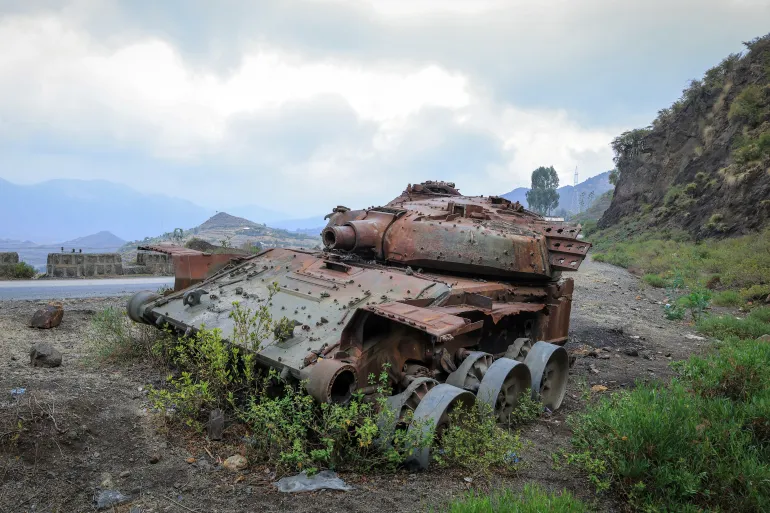
The Tigray People’s Liberation Front (TPLF) ruled Ethiopia from 1991 to 2018 but was marginalized after Abiy took office, sparking a devastating civil war that lasted from 2020 to 2022. According to African Union estimates, the conflict resulted in approximately 600,000 deaths before the Pretoria Peace Agreement brought hostilities to an end.
Clashes Erupt in Afar and Amhara Regions
Citing local humanitarian workers, AFP reported that clashes broke out on Wednesday in multiple locations across the Afar region, including the towns of Abala and Erebti. Reuters, citing two residents, reported that in the Amhara region, federal forces fired heavy weapons at local residents from a camp in the town of Lalibela.
This offensive was launched after the Tigray People’s Liberation Front (TPLF) announced on Sunday an alliance with six other armed groups within Ethiopia to overthrow the Abiy government.
Reuters reported, citing government and diplomatic sources, that forces from the Tigray region are fighting alongside Fano militia in the Amhara region.
Fano is a member of a new alliance formed with the Tigray People’s Liberation Front (TPLF).
During the 2020–2022 war, it sided with the federal government, but in 2023, it turned against the government and became embroiled in an ongoing armed conflict that has claimed thousands of lives.
Abiy’s spokesperson, Billene Seyoum, told Reuters that members of the alliance have been collaborating for some time and have received financial support from Eritrea—Ethiopia’s neighbor and historic arch-rival.
Eritrea has repeatedly denied such allegations.
Speaking at the UN General Assembly in New York, Ethiopian President Taye Atske-Selassie Amde stated that despite foreign interference, Ethiopia has exercised “great restraint” and made progress with its neighbors.
He said: “We send a clear and loud message to those forces of destruction and chaos. We urge them to respect the sacred right of the people of the Horn of Africa to live in peace and prosperity.”
Analysts warn that a resurgence of hostilities could destabilize the region, which has yet to recover from previous conflicts; approximately one million people remain displaced there.
Alan Boswell, the Horn of Africa Project Director at the International Crisis Group, stated that allegations regarding Eritrea’s support for the Tigray People’s Liberation Front (TPLF) could trigger a regional conflict.
“For example,” Boswell said, “Eritrea has quite close ties with the Sudanese military, whereas relations between Ethiopia and the Sudanese military are deteriorating.” He added that Ethiopia is also becoming increasingly entangled in Sudan’s civil war, at least in its border regions.
“So, all of this is evolving into a massive regional upheaval; if we don’t see an easing of tensions, the situation could become very, very bad.”